
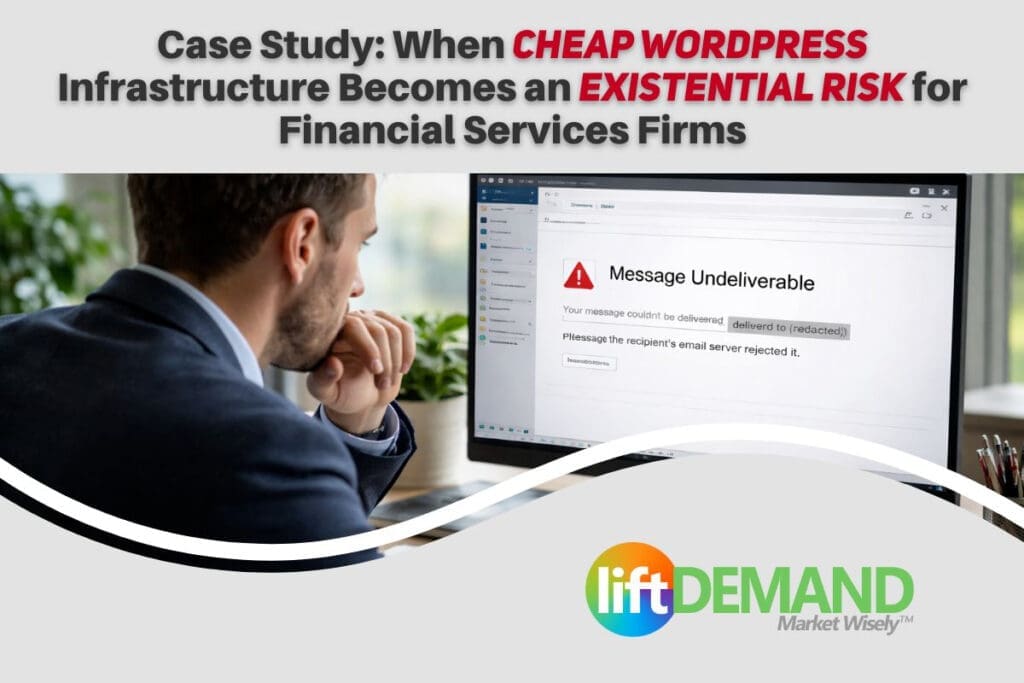
Your website is more than a digital brochure. It is a core part of your digital transformation—an operational system tied directly to trust, productivity, and revenue generation. For regulated firms, like those in financial services, it also extends into email reputation, network infrastructure, and the security posture that interconnected platforms rely on every day. In this case study, a low-cost hosting decision nearly disrupted millions of dollars in active deal flow.
Sage Investco (a property investment / development / management firm) did not come to liftDEMAND looking for a redesign, a new marketing angle, or surface-level performance optimization.
They came to us because their business had unexpectedly entered a failure state.
🎧 Listen to “The 3-Minute Briefing”
Topic: Get the quick perspective on the risks of low-cost WordPress infrastructure for financial services firms in under 3 minutes.
- Prefer to Read? Jump to the 3-minute summary
- Short on time? View the Top 5 Takeaways below
Email had stopped delivering. Their web platform had been flagged by Google as a malware distributor. Microsoft and Google mail servers no longer trusted their domain. Active conversations tied to multi‑million‑dollar investment activity were suddenly at risk—not because of market conditions, but because their underlying WordPress CMS architecture and enterprise hosting infrastructure had collapsed.
This was not a branding problem. It was a systems problem rooted in technology decisions that compound over time.
How the Risk Was Introduced
Sage Investco’s website had been built using a low-cost development arrangement overseas. On the surface, the site appeared functional. Pages loaded. Content displayed correctly. Nothing obvious suggested immediate danger.
But beneath the surface, several compounding decisions created a fragile environment that actively worked against the firm’s business goals:
- An inferior design codebase with limited long-term maintainability
- Poor documentation and minimal ownership transfer
- Out-of-date plugins left unmonitored, creating known security vulnerabilities
- Commodity hosting chosen for short-term savings, not long-term operational costs
- No unified responsibility for content management, application security, or continuity
The site was deployed on an inexpensive shared hosting plan with a major commodity provider. Basic updates occurred sporadically, but no one owned the system holistically. There was no penetration testing, no audit trail, no firewall strategy aligned with finance-sector risk, and no IT roadmap connecting the site to broader business operations.
For a time, this worked—until performance degrades, trust erodes, and the platform becomes a liability.
The Failure Event
The first signal was performance degradation. The site slowed to a crawl. Pages stalled. Administrative access became unreliable.
Speed matters more than most firms realize. When performance degrades, productivity bottlenecks appear internally, Core Web Vitals (a key measure Google uses to help determine site ranking) decline externally, and platform trust begins to weaken long before a visible failure occurs.
Shortly after, the more serious issue surfaced.
Google flagged the site as a malware distributor.
This classification does not happen casually. It typically results from confirmed malicious code executing within a web platform—often injected through vulnerable plugins or poorly governed content management systems. Once flagged, the consequences extend far beyond search visibility.
In Sage Investco’s case, the domain itself became poisoned.
Email systems do not evaluate messages in isolation. They assess the reputation of the sending domain across multiple signals, including website security posture, network behavior, and historical compliance patterns. When a site is compromised, that reputational damage propagates outward.
- Google stopped trusting outbound email
- Microsoft followed suit
- Legitimate business email failed to deliver
- Deal communications silently disappeared into spam filters or were rejected outright
At the time of the incident, Sage Investco was engaged in active deal activity representing millions of dollars in potential transaction value. When email delivery failed, the firm temporarily lost its primary channel for time-sensitive communication—placing those opportunities at risk through no fault of its stakeholders.
From the outside, it looked like instability. From the inside, it was operational paralysis.
Why This Became a Brand-Level and Financial Threat
For an investment firm, digital success depends on more than visibility. It depends on confidence.
A malware warning attached to a finance-sector domain raises immediate red flags:
- Questions about internal controls and audit readiness
- Concerns over data handling and application security platforms
- Doubts about operational discipline and scalability
- Fear of broader exposure across connected systems
This was not simply a technical cleanup. Sage Investco needed to restore confidence—to platforms, counterparties, and internal decision-makers evaluating risk and revenue generation.
liftDEMAND’s Intervention
Our first step was containment.
We performed a full system inspection across the hosting environment, CMS architecture (WordPress core), themes, plugins, and network infrastructure. Multiple malware strains were traced to outdated plugins and theme files that had been exploited—an extremely common attack vector on unmanaged WordPress installations.
From there, the response followed a controlled, auditable sequence:
- Removal of injected malicious code
- Patch and update of all vulnerable components
- Elimination of unnecessary plugins creating security vulnerabilities
- Hardening of access controls and firewall rules
- Identification of attack patterns and source IPs
- Documentation of findings for compliance and future audit review
Once the environment was stabilized, we migrated Sage Investco into our Comply.Press enterprise hosting infrastructure built on Amazon Web Services.
In parallel, accessibility safeguards, privacy controls, and application-level protections were addressed to ensure the platform aligned with modern regulatory expectations—not just short-term recovery.
Why Comply.Press Changed the Outcome
Comply.Press is not generic hosting. It is a compliance-first web platform designed for financial services firms where failure carries measurable consequences.
For Sage Investco, this meant:
- Continuous monitoring instead of reactive updates
- Hardened configurations designed to improve security posture
- Controlled content management and plugin governance
- Isolated resources instead of shared risk
- Clear accountability comparable to a managed IT services provider
This environment supports scalability without introducing fragility—allowing technology to support growth rather than constrain it.
With the site secured and verified as clean, we initiated the trust restoration process.
Restoring Trust with Google and Microsoft
Cleaning a site is only half the battle. Proving that it is safe again is the harder part.
We documented remediation steps, validated the application security platform, and submitted the domain for review. Google’s systems require evidence that root causes have been addressed—not temporarily masked.
Once the domain was cleared:
- Malware warnings were lifted
- Search trust was restored
- Email deliverability resumed
- Business communications normalized
Sage Investco was operational again.
The Broader Lesson
Nothing about this failure was unusual.
This sequence—cheap development, unmanaged infrastructure, silent compromise, platform-level penalties—repeats constantly across finance and professional services.
What made this situation dangerous was not the malware itself. It was the absence of a single point of responsibility connecting technology decisions to business insights and outcomes.
Security, performance optimization, compliance, email trust, and revenue protection are not separate concerns. They are one system.
Comply.Press exists to make that system explicit.
Outcome
| Metric | Pre-Intervention (Shared / Unmanaged) | Post-Intervention (Comply.Press) |
|---|---|---|
| Performance | F (Systemic failure) | B (Stabilized Core Web Vitals) |
| Security Status | Blacklisted (Google / Microsoft) | Verified clean |
| Email Reliability | ~0% (Silently rejected) | Restored delivery |
| Accountability | Fragmented | Single point of responsibility |
- Website performance stabilized
- Active attacks identified and blocked
- Domain trust restored across major platforms
- Email flows resumed
- Operational credibility re-established
Performance recovery was measurable. Prior to remediation, GTmetrix testing (June 2022) rated the site an F. After migration to Comply.Press, the site reached a performance ceiling at a B rating. While infrastructure remediation delivered material gains, the final score was limited by the client’s decision to retain a legacy theme rather than re‑platform onto our hardened baseline.
That constraint directly informed our current policy: all new builds must use our unified core blueprint to ensure an A‑level standard for security, speed, and scalability.
In any case, Sage Investco’s website is no longer a liability. It is an operational asset—aligned with business goals, supported by a clear IT roadmap, and built to withstand scrutiny.
Conclusion
This case study reflects a common reality for professional financial services firms, including accounting, bookkeeping, independent insurance agencies, investment advisors, and cfps: infrastructure decisions made for price instead of adequate security, compliance, and speed often surface later as existential risks to trust with real-world ramifications.
Comply.Press was built not only to recover from these failures—but to prevent them from happening in the first place.
Frequently Asked Questions
- Can a website problem really cause business email to stop working?
- It sounds unlikely until you’ve seen it happen. Email providers don’t treat your website and your inbox as separate worlds. They look at the reputation of the entire domain. If your site gets flagged for malware or suspicious behavior, that trust drops,and email delivery is often the first place it shows up. Messages don’t always bounce. They just… never arrive.
- Why do so many security problems start on “cheap but working” WordPress sites?
- Because nothing is actively watching them. Low-cost setups usually mean shared servers (literally thousands of websites per server), minimal monitoring, and no clear owner once the site goes live. Updates get skipped. Plugins age out. Vulnerabilities sit there until someone takes advantage of them. By the time anyone notices, the damage is already done.
- What actually triggers Google to label a site as unsafe?
- It’s rarely one dramatic event. More often, it’s a small vulnerability that’s been open for a long time,an old plugin, an abandoned theme, a misconfigured file. Once malicious code is detected running on the site, Google acts fast. There’s no warning period and no human conversation at that stage.
- Is site speed really a business issue, or just an SEO concern?
- Internally, speed problems show up as friction. Admin pages lag. Tasks take longer than they should. Teams start working around the system instead of with it. Externally, search engines notice instability and users feel hesitation,even if they can’t articulate why. Speed problems tend to signal deeper structural issues.
- Could this kind of issue affect deals even if a website is low-traffic?
- Yes,and that’s what makes it dangerous. Your domain is still part of how email systems, partners, and platforms decide whether to trust you. When that trust drops, time-sensitive communication can fail without anyone realizing it. Deals simply stall or disappear.
- Why isn’t removing malware enough to solve the problem?
- Because platforms care about why it happened, not just whether it’s gone. If the same conditions still exist,poor governance, weak controls, no monitoring,trust doesn’t come back. Google and Microsoft want to see that the system itself has changed, not just been cleaned.
- What does “compliance-first” hosting look like day to day?
- It looks boring,in a good way. Updates happen on schedule. Changes are controlled. Access is limited and logged. Someone is clearly responsible. Nothing relies on memory or best intentions. That kind of discipline is what keeps small problems from becoming public failures.
- How can a firm tell if its website is quietly becoming a risk?
- When no one can confidently answer basic questions,who owns WordPress updates, how vulnerabilities are identified, what happens if something breaks, that’s a signal. Other clues include unexplained slowdowns, WodPress plugins that haven’t been touched in years, and a general sense that the site is “fine” only because no one has looked too closely.
“The 3-Minute Briefing” Text
This is your 3-Minute Briefing with liftDEMAND
Today We’re Talking About a Case Study: When Cheap WordPress Infrastructure Becomes an Existential Risk for Financial Services Firms
Most firms don’t think of their website as an attack surface or risk for loss of business productivity.
They think of it as marketing. Something that needs to look professional, load reasonably fast, and mostly stay out of the way. Their frame of mind is simply set and forget.
That assumption is where problems start.
In financial services especially, a website is more than a front door. For accountants, bookkeepers, insurance agencies, and financial advisors, it’s part of the trust system your business depends on. It influences how clients and platforms see your domain. Not only search engines and AI’s but how email providers like Microsoft and Google judge your reputation as well.
The case we’ve been talking about didn’t begin with a dramatic breach. It began with a series of small, ordinary decisions. Cheap development. Cheap shared hosting. Plugins that stayed in place because nothing had gone wrong yet. No clear owner once the site was live.
For a long time, everything appeared fine.
Then performance started to slip. Admin access slowed. Pages stalled. Internally, work took longer than it should have. Externally, trust signals weakened. And eventually, the site crossed a line most firms never see coming until it’s too late.
The site was flagged as a malware distributor.
That label doesn’t just affect search visibility. It affects how your entire domain is treated. Email providers don’t separate your inbox from your website. They look at the whole system. Once trust drops for your domain, messages stop landing. Not always with bounce notices. Often messages simply go undelivered.
In this case, active deal conversations tied to millions of dollars in real money were suddenly at risk. Not because of market conditions. Not because of a bad strategy. But because the infrastructure underneath the business failed.
That’s the part many firms miss.
Website security, performance, email reliability, and revenue protection are tied together. They’re part of the same underlying system. When no one owns that system of trust end to end, small issues compound until the failure becomes visible to everyone.
The fix required more than cleaning malware.
Cleaning took care of the symptom. Restoring trust requires changing the conditions that allowed the failure in the first place. Clear ownership. Controlled updates. Real monitoring. Infrastructure designed for accountability… it’s never cheap. But for anyone in financial services, it is required.
Once those pieces were in place, trust could be rebuilt. Search warnings were lifted. Email delivery normalized. Operations stabilized.
The broader lesson is simple, but uncomfortable.
Most firms don’t suffer infrastructure failure because they intentionally invited it. They suffer it because everything seemed fine for a long time until it suddenly isn’t.
The firms that avoid these situations aren’t doing anything clever. They’re consistent. Someone is responsible. Systems are watched even when nothing is broken. Quiet maintenance work gets done before it becomes urgent.
If there’s a takeaway here, it’s this: if your website feels like it belongs to an un-namable “someone else,” or no one at all, that’s worse than neutral. That’s risk accumulating.
The question isn’t whether a system like that will eventually fail. (Because it will.)
It’s whether it happens at a moment you can’t afford… and how much damage it does to your brand, your transactions, your ability to do business as a result.
This concludes your 3-Minute Briefing. Thanks for listening.
Citations & Supporting Resources
The incident described in this article isn’t rare. It’s the predictable outcome of a few common gaps: unmanaged software, unclear ownership, and platform trust systems that react faster than most business teams do. The sources below are plain, verifiable explanations from the organizations that actually run (or regulate) the trust mechanisms discussed in the case study.
- Google Safe Browsing (Malware and Site Warnings)
Google Safe Browsing explains how Google detects and flags unsafe sites, including malware and other harmful behavior. It’s useful context for why a compromised site can quickly trigger browser and search warnings, and why remediation needs to address root cause, not just surface symptoms.
https://developers.google.com/safe-browsing - Sender Reputation in Exchange (Microsoft)
Microsoft documents how Exchange’s anti-spam protections use sender reputation signals to determine what happens to email. While this focuses on inbound filtering, it helps non-technical readers understand a key point from the article: reputation is cumulative, and trust systems make automated decisions based on patterns and signals, not intent.
https://learn.microsoft.com/en-us/exchange/antispam-and-antimalware/antispam-protection/sender-reputation - FTC Safeguards Rule (What Your Business Needs to Know)
This FTC guidance is written for business owners and leadership teams, not IT specialists. It explains the expectation that firms handling customer information maintain a real security program, including processes that anticipate changes and prevent “set it and forget it” risk from building up over time.
https://www.ftc.gov/business-guidance/resources/ftc-safeguards-rule-what-your-business-needs-know
If you read these three sources back-to-back, the theme is hard to miss. Platform trust is systemic. Security problems don’t stay neatly inside the website, and consequences often show up first where the business feels it most: communication reliability, reputational confidence, and operational continuity.